
[BBL L&P Logic Series: Part 2] Training is Innocent; Only Flawed Judgments and a Lack of 'Courage Not to Train' Exist.(Logic 1: Distinguishing Between Necessary and Unnecessary Training)
[BBL L&P Logic Series: Part 2]
The [BBL L&P Logic Series] is not about managing training—it's about designing business impact. We present BBL’s professional judgment framework for HRD to architect performance through a strategic Learning & Performance (L&P) logic.
[Notice] Rather than covering general HRD functions, this article focuses on Learning & Development (L&D) with the goal of driving organizational business results. We discuss how L&D should identify performance gaps and determine the appropriate interventions, with the ultimate objective of maximizing organizational performance.

[BBL L&P Series Roadmap]
Part 2: "Training is Innocent; Only Flawed Judgments and a Lack of 'Courage Not to Train' Exist" (Principle 1: Distinguishing between training and non-training solutions).
Part 3: The Trap of a 4.8/5.0 Satisfaction Score: Why is On-site Performance Stagnant? (Principle 2: Designing a Holistic Learning Experience that leads to results).
Part 4: When All Knowledge is in AI, What Should L&D Design? (Principle 3: Integrating Informal Learning into the workflow).
Part 5: How L&D Becomes a Cost When Performance Cannot Be Proven (Principle 4: Communicating the value of training in the language of business results).
[Part 2] Training is Innocent; We Only Lack the ‘Courage Not to Train’
(Principle 1: Distinguishing between necessary and unnecessary training)
In Part 1, we observed that in an era where AI provides instant answers, the only unique expertise left for HRD is the professional judgment capacity to discern "what truly drives performance." Now that the shelf life of knowledge has become extremely short, training that merely delivers information is no longer a competitive advantage for an organization. Instead, we are left to answer the cynical question from employees: "If I can get the answer from AI in one second, why must we gather here to listen to this training?"
The HRD strategy in the AI era is found not in the "quantity of training," but in the "quality of judgment." The essence of this is the "Courage Not to Train." This is not an act of irresponsible neglect; it is a strategic decision to 1) analyze business and job performance, 2) clearly identify the root causes of business issues, and 3) concentrate firepower only where training is actually required.
1. A Useful Framework for Performance Analysis (SICS+ Map)
The first activity we perform when establishing a training system or developing a course is usually called Needs Analysis. Generally, this involves collecting opinions by asking employees what training they think they need. However, to identify training that directly links to business results, we must strictly distinguish between what employees Want and what the fundamental business Needs. In other words, we must view training as a solution to bridge the gap between the "desired state" and the "current state" of a specific business issue. The starting point of training must be the result of a Business Performance Analysis, meaning it must satisfy the needs of the entire business beyond just the educational needs of individuals.
To ensure reliability during the process of deriving training solutions from performance analysis, a systematic approach is required rather than vague interviews or questionnaires. Practitioners need a tool to guide them in ensuring all necessary elements are reflected when creating an analysis agenda. A useful tool for this is the "SICS+ Logic." Pronounced "Six Plus," it combines the initials of key elements to make them easy for beginners to remember and use as a basic framework for performance analysis:
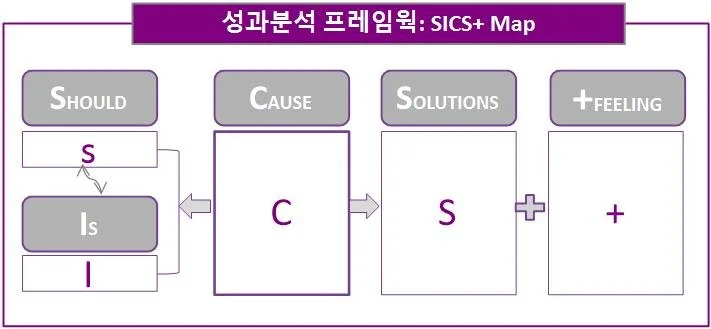
Should (Desired State): Identify the ideal or optimal state, often called the "TO-BE."
Is (Current State): Confirm the actual current state, often called the "AS-IS."
Cause (Root Cause): Identify the real cause creating the gap between the two states.
Solution (Alternative): Seek the optimal prescription to eliminate the cause.
+ Feeling (Emotions): Pre-consider the emotions and reactions stakeholders will feel when the solution is applied in the field.
💡 HRD Performance Note
Real needs analysis is not the collection of employee "Wants" (wish lists), but the process of proving "Needs" (performance deficits) through data. Professional judgment aimed at solving field problems—rather than classroom satisfaction—determines the true success of training.
To support the direction of the business, one must clearly understand the organization's "Core Business." In an era where AI processes vast amounts of data, practitioners must speak the logic and language of the business. Utilizing a Business Logic Model (e.g., Silber & Kearny, 2010) is helpful for this. Often, practitioners with rich educational backgrounds have high expertise in people and learning but lack financial knowledge or business logic, failing to construct proposals that align with management's perspective. Consequently, management fails to recognize the training department as a strategic partner.
A Business Logic Model is divided into the organization's External Environment (trends, opportunities, threats) and Internal Logic (finance, strategy, customer, product, process, and structural logic). Ultimately, an HRD strategy that supports organizational goals is born only through a deep understanding of the business. The solution offered for an organizational problem must strike the root cause that triggered the symptom, not just the symptom itself.
2. A Useful Framework for Analyzing the Cause of Performance Issues (EOI 2.0)
Organizations face significant pressure to improve on-site performance. Because of this, HRD departments may feel an impatient urge to "do something immediately." Today’s exponential technological change can intensify this anxiety. The fear that "we might be falling behind" while technology outpaces human learning can lead to executing training without proper cause analysis.
Taking action without identifying a clear cause is like doing something just for the sake of it without a solid basis. This practice does not help achieve sustainable results for the company. While "taking some action" might offer a momentary sense of relief, the problem is that it is not a fundamental solution.
To prevent this impulsive approach, we utilize the EOI Model. This framework was developed by layering decades of field consulting experience onto the achievements of performance engineering legends, designed for beginners to intuitively remember and apply.
Today, the rapid advancement of technology is not just one element of this framework; it is the massive backdrop that penetrates the whole. Technology changes the external environment while simultaneously reshaping the organization's way of working and the individual's competency map in real-time. Accordingly, BBL Learning has updated the initial model (EOI 1.0) to EOI 2.0, integrating technological change as the underlying environment affecting all factors. Technology is no longer just an external factor; it completely changes organizational processes (O) and redefines the very competencies (I) individuals must possess.
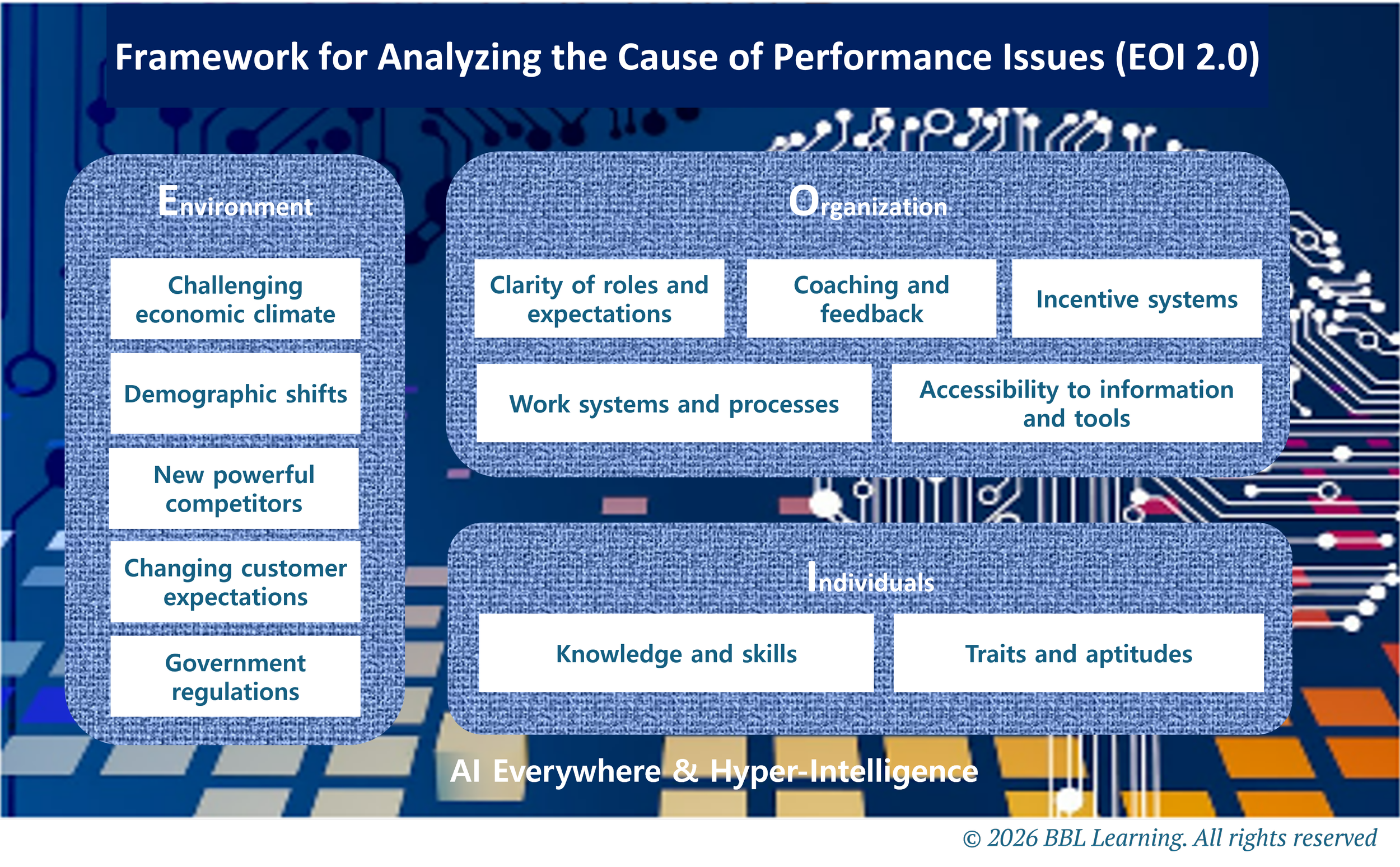
E (Environment): Factors the organization cannot control, such as accelerated technological progress, a challenging economic climate, demographic shifts, new powerful competitors, changing customer expectations, and government regulations.
O (Organization): Internal factors such as clarity of roles and expectations, supervisor coaching and feedback, incentive systems, work systems and processes, and accessibility to information and tools (AI assistants, etc.).
I (Individual): The employee’s knowledge and skills (including the ability to use new technologies), as well as inherent traits and aptitudes fixed throughout their lives.
ⓒ BBL Learning. All Rights Reserved
The key here is to distinguish between the Symptom and the Cause. Common complaints in the field like "We don't have time," "Employees lack passion," or "They aren't motivated" are usually symptoms. If the cause of "lack of time" is complex administrative tasks, the solution should be process simplification. If the cause of "low motivation" is a lack of career opportunities or supervisor indifference, that point must be addressed. Just as a doctor treats the virus (the source of the disease) rather than just the symptom (a runny nose), HRD must solve the source based on Systems Thinking.
💡 HRD Performance Note
Training is not a universal solution. True HRD expertise lies in distinguishing whether the cause of a performance drop is individual competency or the systemic environment, and selecting the optimal intervention at the right time.
3. Impatience from Exponential Technological Change and the HRD Anchor
When technological progress accelerates exponentially, HRD practitioners easily fall into two traps: first, Content Obsession (the urge to reflect every new technology in training courses), and second, Technological Universalism (the belief that technology will solve all problems).
However, while technology permeates all areas of the EOI model and changes the patterns of performance, it does not change the essence of the business—which is "to produce results." In fact, as technology becomes more sophisticated, HRD must avoid getting lost in "technological flashiness" and instead precisely analyze how technology operates between the Work System (O) and Individual Competency (I) to create performance gaps. "Latest technology training" executed without this analysis only gives the organization a false sense of security; it does not lead to substantive performance improvement.
💡 HRD Performance Note
As technology becomes more flashy, HRD must break free from content obsession. The essence is not the technology itself, but analyzing the mechanism of how technology functions between the Work System (O) and the Individual (I) to create performance gaps.
4. HRD’s True Capability in the AI Era: The ‘Courage Not to Train’
Once performance analysis and cause identification are complete, the most necessary trait for an HRD practitioner is, paradoxically, the "Courage Not to Train." In an era where AI pours out information in real-time, the true tragedy for an organization is not "having nothing to learn," but "wasting energy on training that is irrelevant to performance."
If the analysis shows the root cause of a performance drop is the Organizational System (O) or the External Environment (E) rather than Individual Competency (I), the practitioner must be able to firmly state, "This problem cannot be solved through training." Training conducted out of habit because one cannot refuse a request from the field results in more than just a wasted budget; it leads to the fatal perception among employees that "training is an obstacle to work."
The substance of professional expertise for a training manager is the "Courage Not to Train," and this is not a neglect of duty. Rather, it is a strategic decision to propose process improvements instead of training, or to suggest the introduction of AI-based Performance Support tools to accurately strike down performance barriers.
💡 HRD Performance Note
In an era of "Overflowing Intelligence" where AI answers all knowledge, HRD’s capability is determined not by the skill of delivering knowledge, but by the insight to excise the "true cause" hindering performance. The "Courage Not to Train" is the most noble strategic judgment for proposing better alternatives.
5. Solutions by Root Cause of Performance Issues
When the cause is identified, the required solution changes. When a problem is diagnosed with SICS+ logic and the cause is identified through the EOI model, the correct alternative (Solution) can be established.
1) Organizational Environment Factors (E): If the root cause is external, there is limited direct action a training department can take. However, as a Performance Consultant, the HRD department should play a role in proposing and structuring logical solutions for relevant sectors like strategy, marketing, or management.
2) Internal Organizational Factors (O): Solutions such as role clarification or incentive system improvements usually require collaboration with relevant departments. The point the training department should focus on is problems arising from a lack of Task Support Tools. This can be led by the training department under the name of "Performance Support" in terms of structuring knowledge within the organization. Especially in the AI era, rather than making employees memorize everything, the key initiative should be "Learning in the Flow of Work"—preparing knowledge for the exact moment it is needed—thereby returning "learning time" back to "working time."
3) Individual Competency Factors (I): Deficiencies in knowledge and skills can be addressed by the training department. However, inherent factors like aptitude or fixed motivation should be facilitated through collaboration with the HR department and management to be resolved from a recruitment or placement perspective.
According to various studies and the actual experiences of employees, the majority of performance issues (approx. 80–90%, Gilbert, 1978) are solved by changing internal organizational factors rather than individual competencies. This means management solutions other than training may be more necessary. Therefore, even as a training department, the most strategic approach is to consider management changes first and then accompany them with training from a Change Management perspective.
💡 HRD Performance Note
Performance-driven HRD means becoming an expert who designs environment and context beyond just operating training. Since the majority of performance issues are environmental, Performance Support—which returns "learning time" to "working time"—may become the core initiative of HRD.
Closing: Proving Existence through "Not Doing"
Now that you have the courage to filter out the "training that must be done," the remaining task is the sophisticated design to ensure the chosen training leads to performance. In the next part, we reveal the strategy of "Learning Transfer"—organically connecting the periods before, during, and after training to ensure learners don't forget everything the moment they step out the door, and instead drive actual change in the field.
[Preview of Part 3]
Part 3: The Trap of a 4.8 Satisfaction Score: Why is On-site Performance Stagnant? (Principle 2: Designing a complete learning experience that leads to performance). Now that you have the courage to filter out the "training that must be done," the remaining task is the sophisticated design to ensure the chosen training leads to performance. In the next part, we reveal the strategy of "Learning Transfer"—organically connecting the periods before, during, and after training to ensure learners don't forget everything the moment they step out the door, and instead drive actual change in the field.
