
[BBL L&P Logic Series: Part 1] Would the Company Be Okay Even If the L&D Disappeared? Redefining HRD Standards for Performance Architecture
[BBL L&P Logic Series: Part 1]
The [BBL L&P Logic Series] is not about managing training—it's about designing business impact. We present BBL’s professional judgment framework for HRD to architect performance through a strategic Learning & Performance (L&P) logic.
[Notice] Rather than covering general HRD functions, this article focuses on Learning & Development (L&D) with the goal of driving organizational business results. We discuss how L&D should identify performance gaps and determine the appropriate interventions, with the ultimate objective of maximizing organizational performance.

[BBL L&P Logic Series Roadmap]
Part 1: Why Corporate L&D is Getting Harder in the Age of AI (Introduction: The need for a professional judgment framework).
Part 3: The Trap of a 4.8/5.0 Satisfaction Score: Why is On-site Performance Stagnant? (Logic 2: Designing a Holistic Learning Experience that leads to results).
Part 4: When All Knowledge is in AI, What Should L&D Design? (Logic 3: Integrating Informal Learning into the workflow).
Part 5: How L&D Becomes a Cost When Performance Cannot Be Proven (Logic 4: Communicating the value of training in the language of business results).
Why Corporate L&D is Getting Harder in the Age of AI
In an era where the shelf life of knowledge has shortened and AI provides instant answers, the "delivery" function of HRD has become obsolete. Our remaining unique expertise lies in our judgment capacity—the ability to discern "what truly drives performance." On the front lines, employees are increasingly solving problems not through formal training, but through various digital tools and immediate information retrieval. This makes the judgment of "when training is actually necessary" even more difficult. Rather than demanding new roles, these changes force us to question the standards we have long taken for granted.
For example, in a survey conducted about a decade ago (Executive Board Council, 2009), when asked, "If the training department disappeared today, would there be a problem with employee performance?" 56% of executives responded, "It wouldn't be much of a problem." While some respondents viewed the value of the training department positively, the point we must focus on—if we are serious about performance-driven HRD—is why more than half did not perceive the absence of the department as a problem.
As the technological environment and work methods change rapidly, employees are no longer "people prepared through training." Instead, they have become individuals who learn autonomously while performing their duties and solve problems using AI and digital tools. In this situation, HRD cannot simply apply its old performance logic. We must redefine our role by re-examining our standards, defining performance issues, and clearly establishing intervention points.
1. Why the Role of the L&D Drifts Away from Performance: "Training is Innocent; Only Flawed 'Judgments' Exist"
As the corporate environment shifts, cases where the training department's role is seen as disconnected from performance usually occur in the following scenarios:
When it ends with the operation of knowledge-delivery-centered programs, and the learned content is not applied in the workplace.
When the effectiveness of training is evaluated solely through participation rates or satisfaction metrics, without performance analysis.
This gap has become even more apparent with the widespread use of digital technology and AI. We must move beyond the "4.8 Satisfaction Trap"—being content with learners enjoying themselves—and instead scrutinize whether the training was an "intervention" that created actual performance. Since many employees today perform immediate problem-solving and learning during the work process, traditional training alone struggles to contribute sufficiently to substantive results. Therefore, for a training department to fulfill a performance-centered role, it must move beyond simple execution and equip itself with a "professional judgment framework for defining performance issues and designing intervention points."
💡 HRD Performance Note
The success of training depends not on classroom satisfaction, but on the professional judgment of the L&D practitioner in addressing real-world performance gaps.
2. HRD in an Era Where Work and Learning Are Inseparable: When All Knowledge is in AI, What Should HRD Design?
In an age where AI provides immediate answers to all knowledge, training that merely delivers information loses its reason for existence. If a judgment framework for performance is the core, we must rewrite the very "definition of learning" that serves as the basis for that judgment.
Learning no longer occurs only during specific "training hours." Whether through formal learning or informal learning, employees select the learning they need within their work context and solve problems using various digital resources and tools.
As the boundary between work and learning blurs, "Learning in the Flow of Work" is no longer just a slogan but a condition that can be realized in the actual work environment. In this situation, if we only consider knowledge-delivery-centered training, "Just-in-case" training—based on the vague hope that "it might be used someday"—is bound to be ignored. This is also why the executive perception that the absence of a training department wouldn't significantly impact short-term performance feels somewhat valid. HRD must move beyond being a knowledge deliverer and transition into the role of designing the "environment and context" so that learning can occur organically where employees work. As AI replaces knowledge, HRD must focus not on the volume of knowledge, but on the "context that leads to performance."
💡 HRD Performance Note
HRD in the AI era must transition from being a knowledge deliverer to being an "expert who designs the environment and context" so that learning can occur organically in the flow of work.
3. How L&D Becomes a Cost When Performance Cannot Be Proven: Why and When Does an Organization Choose Training?
If leadership doubts the necessity of the training department, it may be because the language of HRD does not align with the language of business performance. When training fails to prove performance relative to investment, L&D is regarded as a "simple cost" rather than a strategic partner. Therefore, we must be able to answer the following questions ourselves:
"Is this a critical performance issue worth investing a limited budget in?"
"What behavioral changes can be proven in numbers after the training?"
"How can we maximize the effectiveness of training in the workplace using tools like AI?"
Ultimately, the core lies in the fundamental judgment of "Why and in what cases does the organization choose training?" This is because, as the technological environment becomes more sophisticated, it is increasingly difficult to distinguish whether the cause of a performance drop is a lack of individual competency, an inefficient work process, or limitations of tools and the environment. This expands into the following strategic judgment issues:
Mode of Intervention: In the process of addressing organizational performance issues, how should HRD intervene?
Concentration of Resources: Where should limited training resources and budgets be focused?
Demarcation of Domains: Which performance issues should be judged as belonging to the realm of "training"?
Transfer Bottlenecks: Why is the content covered in training not being sufficiently utilized in the field? (Transfer of Training)
Verification of Value: Through what changes can the effectiveness and value of training be confirmed?
Practitioner Competency: Does the L&D practitioner possess the analytical skills and technological understanding to perform these judgments?
AI and digital technology are not the ends of HRD themselves. As AI increases the speed of knowledge delivery infinitely, ironically, the HRD judgment capacity to discern "Does this knowledge really lead to performance?" becomes a rarer and more valuable asset. The key is not the use of the tool itself, but a judgment framework that can design and distinguish between training, performance support, job redesign, and technological supplementation depending on the nature of the performance issue.
💡 HRD Performance Note
Training is not a universal solution. The true skill of HRD lies in distinguishing whether the cause of a performance drop is competency or environment, and selecting the optimal intervention at the right time.
4. Four Core Principles for HRD Addressing Performance Issues
Then, with what logic should HRD move in the face of these complex performance issues? The four practical principles proposed by BBL can be described as a roadmap to transition the role of HRD from "event management" to "performance improvement."
Here, we summarize the four design criteria and key points to consider for practical application to handle performance issues specifically.
① [Performance Analysis] Distinguish between training that must be done and training that does not need to be done.
Clearly distinguishing what to train and what not to train becomes a decisive practice. Depending on whether the cause of the performance drop is a lack of individual competency, a process/system problem, or a limitation of tools and environment, one must distinguish between training and non-training solutions.
Example: When introducing a new CRM system, instead of a simple feature introduction, select the target and content of training focused on core functions linked to sales performance improvement. This prevents wasting resources on unnecessary training and focuses on learning directly related to results.
② [Learning Design] Design a complete learning experience that leads to performance.
It is important to design a complete learning experience that encompasses the periods before, during, and after training, rather than leaving the performance of the training to chance.
Example: After project management training, assign practical tasks for each team and check progress and results with AI-based performance tools. Through a cycle of Clarifying Expected Results → Work-linked Tasks → AI/Digital Check and Feedback, the possibility of connecting to actual performance is increased.
③ [Workflow Implementation] Support so that work and learning are not separated.
If past training stopped at "delivering" knowledge in a specific space called a "classroom," the new battleground for HRD is the field where employees actually perform their work. Do not dichotomize formal and informal learning; instead, combine them organically. Realize a work-centered learning environment so that learning can occur immediately at the "Moment of Need"—the critical moment when employees must solve performance problems using AI and digital tools.
Example: Link customer consultation script training content so that employees can immediately refer to it through mobile learning apps and CRM systems during actual consultations. The training department connects formal content with digital tools, and the manager provides checkpoints to encourage practical application, thereby maximizing the transfer rate of learning.
④ [Result Verification] Explain the value of training in the language of performance.
The value of training must be explained in the language of business performance, and the results must be fed back as improvements. Evaluating solely by participation or learning achievement is not enough.
Example: Sales training should not end with attendance rates and quiz scores but must be linked to whether it was applied on the job, changes in work methods, and improvement in sales and customer satisfaction metrics. While this is one of the most difficult tasks for L&D practitioners, if one accurately identifies performance issues and properly designs and operates a complete learning experience aimed at solving those problems, the process of linking the effectiveness of training to business performance is no longer daunting.
💡 HRD Performance Note:
Performance-driven HRD transforms training from a simple administrative task into a professional judgment framework that creates business value through the four-step principle of [Performance Analysis - Learning Design - Workplace Operation - Result Verification].
The four steps examined so far are not just a simple checklist. They are like a "Decision-Making Map" that helps L&D practitioners avoid getting lost amidst the numerous variables they face in the field. Here is a summary so you can see at a glance what judgment (Decision Point) to make at each moment and what to do to turn that judgment into action (Key Activity).
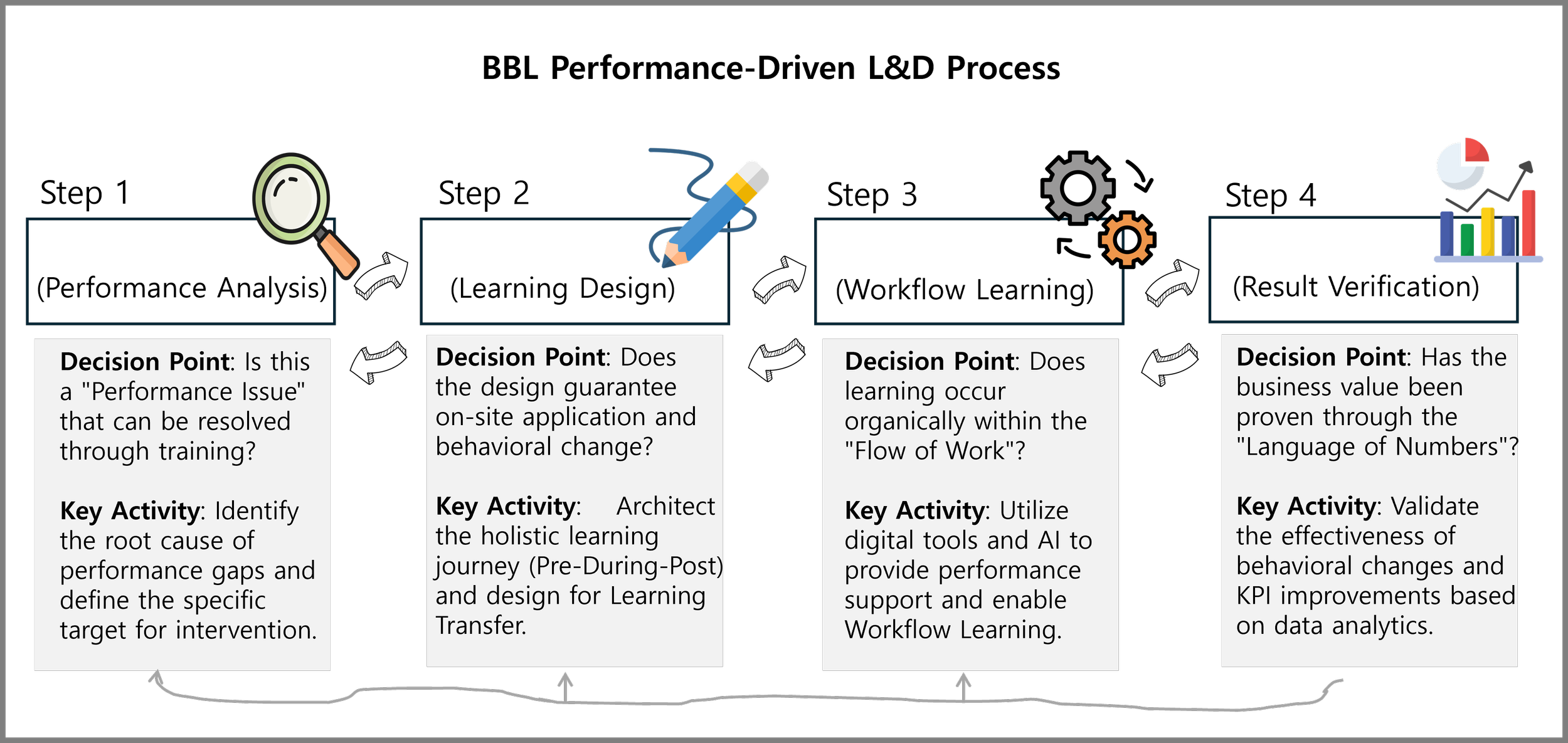
[BBL Performance-Driven L& D Process] This is BBL’s proprietary four-step professional judgment framework, designed to move beyond traditional knowledge-delivery training. It focuses on defining on-site performance issues and proving business impact through tangible results. Each stage is organically linked, and the data gained through Step 4 (Result Verification) serves as a strategic asset to further refine the precision of initial analysis and design.
Closing: Toward a Performance-Centered Professional Judgment Framework
In a world where the technological environment changes every day, HRD cannot respond by blindly adding new tools. Rather, it is important to define performance issues, judge where training should intervene, and audit the practical standards for structuring learning experiences and workplace support.
When checking HRD practices against these questions, training can move beyond a simple execution function and establish itself as a professional judgment framework that defines organizational performance issues and designs/selects intervention points. Especially amidst changes in the technological environment including AI, HRD must make its core role the distinguishing of problems where training should intervene from those where it should not, and structuring those interventions so they lead to performance.
This article is an introduction outlining how HRD handles performance issues and judgment criteria. In the following series, we will cover the four core principles mentioned above more specifically in order.
[BBL L&P Logic Series: Part 2} Preview: HRD in the AI era no longer "delivers" knowledge. We "judge" performance and embed those solutions within the employee's workflow. This is the standard of corporate training defined by BBL Learning.
What is your organization basing its training judgments on? Please share your thoughts in the comments.
