
I Am the Author of My Life: Youth Life Leadership—Connecting Who I Am Now with Who I Want to Become
🌀 About the Youth Life Leadership Series
This article is the first in a series that explores how young people can live with the mindset “I am the Author of My Life”—strengthening their ability to connect who they are now with who they are becoming.
Grounded in the Youth Life Leadership 4E Model (Exploring — Envisioning — Engaging — Enabling), the series will gradually address youth development, the role of parents and caregivers, and learning from a broader global perspective.

For many teenagers, the word “leadership” can feel like a heavy label.
Some say, “I’m not really the ‘leader type.’”
Some parents ask, “Isn’t leadership something they need when they’re older?”
But Life Leadership is not about leading others.
It is the strength to lead one’s own life — to navigate choices, challenges, and meaning with intentionality.
This capacity does not belong only to a certain personality type. It is something every young person can gradually develop in daily life.
Teenagers are not simply “preparing for the future.”
Their life is happening now, day by day.
How they experience and interpret these days naturally shapes the kind of future they will create.
A balanced perspective — one that honors both the present and the future — is the starting point of Youth Life Leadership.
This is why we must view leadership not as a role or a personality trait, but as a way young people live and make sense of their own lives.
Cultivating the Sense of “Being the Author of My Life”
Becoming the Author of My Life does not require bold decisions or dramatic achievements.
It begins in small, everyday moments when a young person senses that they can choose for themselves:
The moment they pause to notice their emotions instead of being swayed by someone else’s words,
The moment they stop between what they must do and what they want to do,
The moment they ask themselves what kind of friend they want to be when someone is struggling,
The moment they take a tiny step forward, even when a new possibility feels intimidating.
These quiet, accumulated choices help teenagers experience a growing sense of agency —
“I am shaping my own life.”
This sense of authorship is at the heart of Life Leadership.
No Teenager Grows Alone
A young person does not build Life Leadership in isolation.
There are always adults beside them — parents, caregivers, teachers, coaches, mentors, neighbors.
What matters is this:
Leadership is not something adults teach or impose.
It is something young people discover when adults create the right conditions for them.
The most meaningful role an adult can play is offering the message,
“Your life holds possibilities,”
— not through pressure or comparison, but through respect and genuine support.
Growing as a Globally Minded Young Person
Many programs emphasize “global experiences” when discussing youth development.
At BBL Learning, global experience is not simply travel or cultural exposure.
It is the process of deeply understanding the lives and realities of others.
Interactions with peers in different social and cultural contexts — including those growing up with fewer resources — hold unique educational value because they allow young people to:
Understand global inequality and diversity through real relationships.
Meeting peers who live under different circumstances helps them learn, through connection rather than information, that the world is profoundly diverse.Witness resilience and possibility in others’ lives.
Young people in developing contexts often show remarkable resilience in limited environments.
These encounters give teenagers fresh perspective on their own lives.Form a relationship-based worldview — not just “global competence.”
Our goal is not to train students to look at the world, but to stand with others in it.Develop a sense of responsibility as members of a global community.
They begin to ask naturally,
“How can I contribute to a better world?”
This is the foundation of Global Life Leadership.
Youth Leadership Is Not About Teaching the ‘Right Answer’
Life Leadership is not about delivering content, methods, or answers.
It is an experiential process in which teenagers act, reflect, and make meaning.
Leadership education is not the question “What should I do?”
but the deeper exploration “How do I want to live?”
To help young people translate this philosophy into everyday life, we structure Life Leadership around four experiential domains.
When these experiences repeat and deepen, the foundation of Life Leadership is formed.
The 4E Model of Youth Life Leadership (YLLM)
Exploring – Envisioning – Engaging – Enabling
The 4E Model offers teenagers a way to experience agency in their daily lives.
It is not a strategy for academic performance or a checklist for university admissions.
It is a lens for understanding personal growth — moving from:
Who I am now → Who I want to become → How I connect with the world → How I create change.
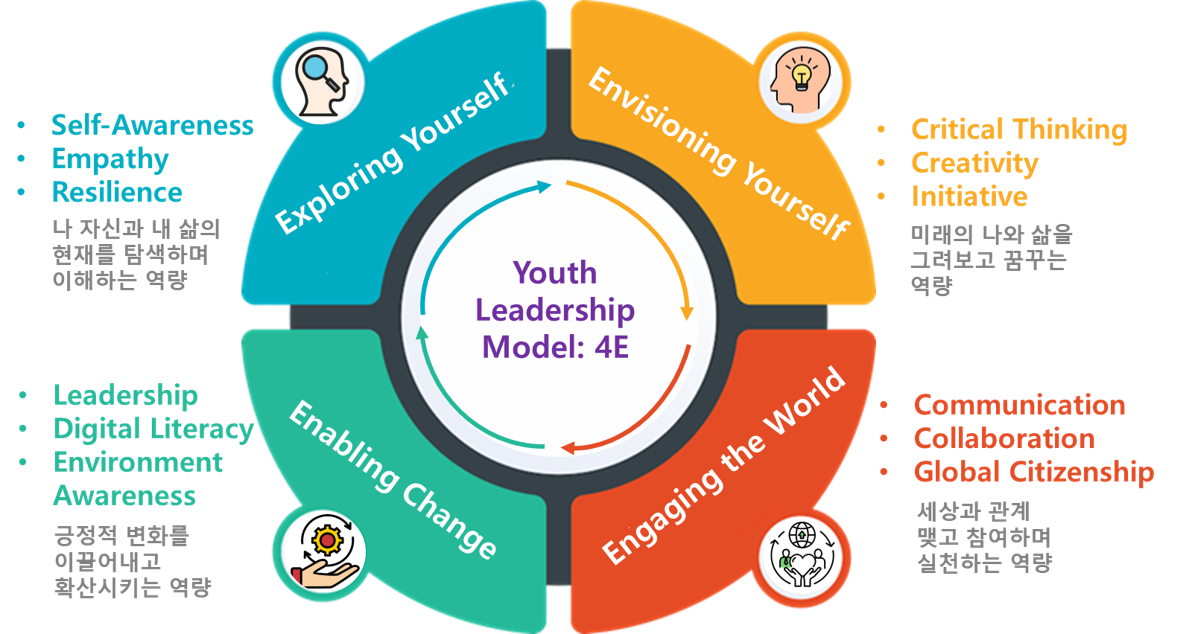
1) Exploring Yourself — Understanding Who You Are
True growth begins with knowing oneself.
Exploring Yourself is the journey of examining strengths, values, interests, emotional patterns, and contexts in which one thrives.
Only those who understand themselves can move toward the life they truly want.
Parents play a key role here — not as observers, but as partners in conversation and shared experiences.
Key Point:
This stage is not about defining identity, but cultivating curiosity about oneself.
Exploration leads to understanding, not judgment.
2) Envisioning Yourself — Imagining Who You Want to Become
This is not about choosing a job but crafting a sense of direction.
Envisioning Yourself helps young people imagine future possibilities and reflect on the values, attitudes, and readiness needed to grow toward them.
A clear vision gives courage, even in uncertainty.
Questions such as:
What values matter to me?
How do I want to relate to the world?
What environments help me grow?
These are not career decisions — they are life decisions.
Key Point:
The future does not appear suddenly.
It slowly takes shape through accumulated thoughts.
This process is mapping “the landscape of my possibilities.”
3) Engaging the World — Expanding Through Connection
We grow through relationships.
Engaging the World gives teenagers experiences that expand their worldview and their sense of belonging in the world.
Encounters with peers from different countries — including those from developing regions — often lead to profound growth.
They realize:
We are different, but we can understand each other.
The world is wider than I thought.
I am already connected to the world.
Parents also gain a new perspective of their child as “a person who exists in relationship with the world.”
Key Point:
Global engagement is not just exchange activities or service trips.
It is the human experience of meeting others whose lives differ from ours and feeling a deeper sense of connection and shared humanity.
4) Enabling Change — Turning Choices Into Action
Change begins with small, consistent actions.
Enabling Change helps teenagers develop the capacity to act on what matters — in their own lives, relationships, and communities.
Life Leadership is expressed in the tiny, everyday decisions that strengthen both the present self and the future self.
Key Point:
Change does not start only with grand initiatives.
It begins with a single new choice today.
A teenager grows into a person who creates change not because they are told to “change the world,” but because they realize their actions, however small, create ripples.
Life Leadership Complements — Not Replaces — School Education
Schools build knowledge and foundational skills.
Life Leadership does something different:
it helps young people make what they learn come alive in daily life.
Whether in academics, relationships, identity, or worldview, the 4E Model supports teenagers in weaving their experiences into the story of their own life.
Ultimately, Life Leadership Is the Ability to Be Surprised by One’s Possibilities
Not the adult’s standard of a “successful teenager,”
but a young person who can say,
“Living my life, I’ve discovered who I am becoming.”
Becoming the author of one’s life is not about pursuing grand success.
It is about staying connected to one’s own story —
balancing the power to live fully in the present with the courage to grow into the future.
This is where Youth Life Leadership shines most clearly.
This article is an introduction to the overall structure of Youth Life Leadership.
Future articles will explore each domain in detail and outline the principles for designing transformative learning experiences.
This document was authored by Dr. Mijeong Kim and officially published by BBL Learning.
