
A global learning ecosystem in which youth design their own lives with agency through cross-border learning and practice.
1. Introduction: In the Age of Technology, Reconsidering the Essence of Humanity and the Field
In an era in which Artificial Intelligence (AI) is streamlining many aspects of daily life, the focus of education is paradoxically shifting toward the dimensions that technology cannot easily replace: the complexity of real-world contexts and the depth of human relationships. It is particularly encouraging that public education systems have recently pursued diverse innovations—such as the introduction of the IB (International Baccalaureate) curriculum and the expansion of Project-Based Learning (PBL)—in order to move beyond standardized knowledge transmission and cultivate creative and critical thinking capacities.
However, despite these institutional reforms, adolescents still struggle to overcome the anxiety associated with deviating from prescribed pathways, as the immense framework of university entrance examinations continues to operate with considerable force. As classroom learning becomes increasingly centered on measurable academic “achievement,” there remain significant limitations in nurturing the capacity to respond autonomously to the multifaceted challenges of the real world and to forge one’s own path beyond the classroom.
The Youth Life Leadership Program (YLLP) was designed in support of these transformative movements within public education, while simultaneously seeking to extend the authenticity of learning beyond the outcome-oriented goal of university admissions and into lives across borders. Moving beyond the mere acquisition of knowledge, YLLP places “agency”—the capacity to connect with others in real contexts and to actively steward one’s own life—at the center of its educational philosophy.
This paper explores the principles of holistic learning design through which adolescents grow into “authors of life” beyond the boundaries of nation and culture, focusing on the four domains of the Youth Life Leadership Model (YLLM) and the dynamic technological and human ecosystems that sustain it.
2. The 4E Framework of the Youth Life Leadership Model (YLLM): Twelve Competencies Forged Through Challenge and Reflection
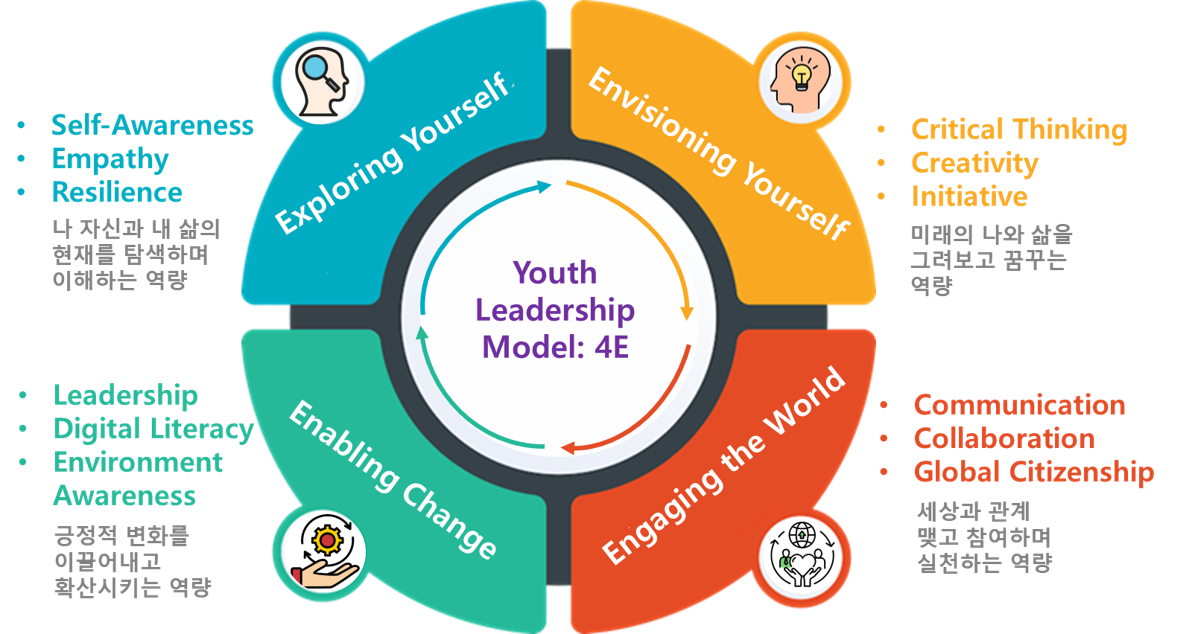
The Youth Life Leadership Model (YLLM) is a systematic framework that organizes twelve core competencies manifested through collaborative problem-solving among adolescents from diverse environments. The model traces a developmental arc of leadership that expands from the inner self toward the world through four essential questions:
Youth Life Leadership Model
Who am I?
What kind of person do I want to become?
How do I connect with the world?
What kind of change can I create?
This developmental trajectory encompasses the essential competencies required for young people in the twenty-first century and provides practical criteria through which adolescents can design and enact self-directed lives.
© BBL Learning | Unauthorized use is prohibited.
[1] Exploring Yourself: Establishing Agentic Identity Through the Mirror of Others
Many adolescents lose sight of their own uniqueness while conforming to parental expectations or dominant cultural norms. Deep self-exploration often becomes more vivid when individuals leave familiar environments and encounter others whose life trajectories are profoundly different from their own. Korean adolescents, for instance, gain opportunities to objectively reassess the environments they have long taken for granted by engaging with peers in developing countries. Through this process, they expand their self-awareness and experience a form of ontological humility.
One day, during a presentation, a Korean student spoke about the psychological depression experienced by many Korean adolescents within an intensely competitive society. After the presentation, a student from Laos carefully asked:
“Why do you continue competing when it is that painful?”
The Korean student found himself unable to answer easily.
At that moment, for the first time, he began to view the standards of life he had unquestioningly accepted as strangely unfamiliar.
Within YLLP, self-exploration is not simply the process of defining “what kind of person I am.” Rather, it is closer to rediscovering “through what standards I have been viewing the world.”
This reflective process occurs equally among adolescents in developing countries. Through the perspectives of others, they rediscover the intrinsic value and potential within their own lives and communities, recovering self-esteem not as passive beneficiaries but as protagonists of change. Such experiences cultivate empathy toward the unique contexts of others and enable adolescents to transform the shock of unfamiliar environments into energy for growth, reconstructing dependent identities into agentic selves.
[2] Envisioning Yourself: Creative Agency that Transforms Deficiency into Possibility
Whereas conventional education has often implicitly emphasized climbing pre-established ladders of success defined by personal prestige or economic achievement, YLLP’s approach to future planning is rooted in creative agency that transforms the “deficiencies” of life into new possibilities.
The capacity to envision one’s life is often cultivated more clearly in environments of urgent necessity than in conditions of abundance. Adolescents in developing countries broaden their horizons and gain motivation for self-direction through engagement with new worlds, while Korean adolescents discover meaningful directions in which to channel their own energy through supporting the lives of others. In doing so, vague images of the future begin to crystallize into forms of practical leadership.
[3] Engaging the World: Practicing Communication and Solidarity Across Real Barriers
Whereas conventional global exchange programs often remain at the level of cultural experience or temporary social interaction, YLLP connects participants around the goal of “real-world problem-solving.”
The encounter between two groups separated by different physical environments and languages constitutes, in itself, a highly demanding educational challenge. As adolescents struggle to communicate sincerely through imperfect language and limited digital tools, they gradually internalize the deeper meaning of authentic communication beyond superficial conversation.
In particular, collaboratively addressing issues faced by villages in developing countries through remote engagement requires advanced collaborative competencies capable of overcoming physical distance. The bonds formed through this process deepen into a sense of global citizenship grounded in mutual recognition as equal partners.
[4] Enabling Change: Creating Value in the Field Through Practical Use of Technology
The value of leadership is not fulfilled through abstract discourse alone, but through practices that bring tangible warmth into the lives of others. The process through which adolescents from different countries exchange ideas and pursue small but meaningful changes through online platforms becomes, in itself, a training ground for practical leadership.
Central to this process is the concept of “technological sovereignty”—the capacity not merely to consume technology, but to intentionally select and utilize technologies according to the problems one seeks to solve.
Participants define AI and digital literacy not as ends in themselves, but as sincere “tools for solution-making.” Grounded in environmental sensitivity that respects local ways of life, they develop efficacy as practical agents who exercise sovereignty over technology rather than becoming subordinate to it.
3. Core Methodology: Action Learning Through “Authentic Challenges” and Mechanisms of Competency Transfer
Learners continuously expand their perspectives through a cyclical process of: Act → Reflect → Learn → Plan
Cyclical Growth Process: Act- Learners directly confront local challenges by interviewing parents and village leaders and implementing potential solutions. Reflect- They critically examine the limitations encountered during implementation and ask themselves questions such as: “Is our proposal truly meaningful within the local context?” Learn - Through reflection, they acquire new knowledge and deeper understanding of others. Plan- Based on these insights, they design more refined and empathetic next steps.
For example, during a regional project in Honduras, one Korean student proposed introducing a “waste separation system” to improve the village environment. Contrary to expectations, village leaders responded that the proposal would be difficult to implement realistically.
Initially, the student felt confused.
“It is a good idea—why is it not being accepted?”
However, through subsequent reflection, she realized an important truth: introducing waste separation alone would not solve the issue unless downstream waste-processing systems and national infrastructure also functioned effectively. Without such systems, sustainability would remain extremely limited.
Through this experience, she learned that problem-solving is not merely about presenting “efficient solutions,” but about deeply understanding the contextual and structural realities within which people live.
Gradually, her perspective shifted from “what I think is necessary” to “what the community can realistically and sustainably embrace.”
Interestingly, this experience of failure became the starting point for new creative challenges. The student later continued exploring environmental issues and eventually expanded his inquiry into the development of eco-friendly alternative materials such as bio-based plastic films.
Within YLLP, failure is not treated as a deduction factor. Rather, it functions as a critical turning point that propels learners toward deeper understanding and more mature forms of practice.
Efficacy Through Field-Based Practice: Whereas conventional schooling often confines knowledge to the classroom, YLLP sends adolescents into real communities. Through this process, they realize how knowledge connects to life itself and gain tangible efficacy from witnessing that their voices can generate meaningful change.
Educational Utilization of Challenge: The “discomfort” created by language barriers and limited infrastructure functions as an intentionally designed educational mechanism that encourages learners to exercise deeper patience and mutual respect. By overcoming these challenges, learners develop powerful capacities to transfer the insights gained into other domains of life.
4. Foundational Design Principles: A Cross-Border Learning Ecosystem (Youth Life Builders)
[1] Agents and Facilitators of Growth: Creators, Facilitators, and Learning Coaches
Adolescents themselves serve as the principal agents (“Creators”) of the learning process, while local teachers functioning as Learning Facilitators closely support their reflective journeys. Instructional designers assume the role of Master Learning Coaches, maintaining the philosophical balance of the entire ecosystem while empowering local educators and ensuring the quality of learning.
[2] Structures of Support and Governance in the Field: The Role of School Leadership
For many local teachers, the action-learning approach—through which learning and life become deeply interconnected—appears highly innovative and transformative. Consequently, strong trust and collaboration established through intensive communication among school leadership, local educators, and the instructional designer (Master Learning Coach) become essential governance mechanisms determining the success of the program.
[3] Partners in Knowledge and Emotion: Community Knowledge Partners and Parents
Village leaders and parents function not merely as protectors of adolescents, but as “partners in sharing tacit knowledge” capable of helping address authentic field-based challenges.
The Role of Village Leaders and Local Parents: As adolescents explore community issues and seek solutions, these adults become vital sources of living knowledge containing the historical, environmental, and cultural contexts of the community. By participating in defining local problems and assessing the feasibility of solutions together with adolescents, they themselves experience opportunities for rediscovery and learning as adult learners.
Relational Benefits with Korean Parents (Life Sponsors): Korean parents provide emotional solidarity by recognizing unfamiliar challenges and discomforts experienced by their children as necessary processes of growth. In particular, the shared experience of contemplating issues in developing-country contexts and observing the practical journeys of their children transforms conversations within families from “academic achievement” toward “social values and attitudes toward life.”
Reconstruction of Relationships: Through this process, adolescents begin to perceive their parents not merely as “protective authority figures,” but as “life mentors” who trust and support them through difficult journeys. Likewise, parents begin to view their children not as passive recipients of protection, but as independent and agentic leaders.
During a program in Laos, one Korean adolescent watched with surprise as his mother delivered a lecture on traditional Korean attire to local students as a professional expert. The student remarked:
“I see my mother differently now. I have come to respect her.”
This was not simply a moment of discovering a new side of his parent. Rather, the adolescent began to perceive his mother not merely as someone who manages and guides him in daily life, but as an individual possessing her own life, expertise, and capacity to positively influence others—a genuine “leader of life.”
In this sense, YLLP is not merely a program that transforms adolescents; it seeks to reconstruct relationships between parents and children, and between generations themselves, within the broader process of learning. Such relational transformation becomes one of the most powerful emotional foundations supporting adolescents as they design their own lives agentically.
[4] Sustainable Virtuous Cycles: Alumni Mentors & Mentorship
One of the most distinctive characteristics of this ecosystem is its virtuous cycle through which learning experiences continue across generations rather than ending with program completion.
Intermediate Outcomes of Growth and Role Models: University students who return as Alumni Mentors become more than senior peers; they serve as the closest and most tangible role models demonstrating the possibility of transformation. They represent intermediate manifestations of how the educational values pursued by YLLP become internalized within an individual’s life.
Expansion of Learning Through Mentoring: As mentors guide younger participants, they objectify and reinterpret their own past experiences while systematizing what they have learned. In doing so, their own growth expands further. Learning does not conclude here; rather, it deepens and becomes enriched through supporting the growth of others.
Catalysts Toward Authentic Leadership of Life: Through mentoring activities, these individuals internalize responsibility as leaders and grow into “true leaders of life” who positively influence not only their own lives but also the lives of others. This virtuous cycle transforms each participant into a catalyst for collective growth, enabling the entire ecosystem to sustain and continuously develop itself.
[5] Foundations of International Cooperation: Local Partners
For a cross-border learning ecosystem to function sustainably, the role of local partner organizations—those with the deepest understanding of local cultural and administrative contexts—is indispensable. Their role extends far beyond operational support and includes strategic partnership functions such as:
Securing Accessibility and Building Trust: They coordinate trust relationships among village communities, schools, and parents, while establishing the physical and social foundations that enable adolescents to safely access real-world data and engage in practical activities
Cultural Bridge: They prevent cultural misunderstandings that may arise during interactions between adolescents from different countries and provide philosophical guidance ensuring that local values and traditions remain respected within the learning environment.
In summary, the “Youth Life Builders” ecosystem is a collaborative community in which adolescents (“Creators”) become the principal agents of learning under the careful guidance of instructional designers; local teachers (“Facilitators”) and partners create spaces for learning; parents and village leaders become sources of knowledge; and university mentors (“Alumni”) embody visible evidence of growth.
Within this ecosystem, every participant shares in the learning process from their respective positions. Adolescents discover themselves through others; adults rediscover their communities through the perspectives of youth; mentors deepen their own learning through teaching. This resonance of learning constitutes the true driving force behind the sustainable international cooperation education envisioned by YLLP.
5. Digital Reflective Portfolios and Shared Spaces: Visualizing Growth
YLLP operates a dedicated digital platform enabling all ecosystem participants to remain connected across physical distance. This forms the core of a “phygital” strategy integrating digital systems with field-based experiences in order to systematically transform traces of learning into enduring assets.
The Learning Hub: This shared online space serves as a collaborative environment in which all “Life Builders” exchange materials and communicate in real time. Integrated with a Shared Drive system, the platform enables adolescents from different countries to observe how each other’s ideas evolve into concrete action, thereby generating continuous motivation for learning.
Digital Reflective Portfolios (Self-Narrative Asset): All learners document their journeys through media best suited to their individual styles, including essays, photo albums, and video stories. This is not merely the submission of assignments, but a process of weaving fragmented moments of challenge and reflection into coherent narratives of growth.
The true value of these shared spaces and portfolios extends far beyond simple archiving:
Objective Recognition of Growth and Efficacy: Through their portfolios, learners visually recognize how they have changed from the beginning of the program to the present. This provides not a vague emotional impression, but a concrete sense of achievement grounded in documented evidence—becoming a psychological asset they can revisit when confronting future challenges.
Social Validation and Social Recognition: Artifacts shared on the digital platform receive feedback and encouragement from all ecosystem participants, including parents, teachers, and mentors. Such experiences of social validation enable adolescents to recognize that their activities have made tangible contributions to the community and support the internalization of healthy civic consciousness.
Assetization of Knowledge and Transfer of Learning: Digital records accumulated through online collaboration later function as unique portfolios demonstrating authentic problem-solving competencies as learners design future career paths or enter broader society. In this way, learning does not terminate with the end of the program, but becomes a powerful bridge into subsequent stages of life.
6. Distinctions from Conventional Educational Models: Recovering “Sovereignty Over Life” Beyond Achievement
YLLP presents differentiated perspectives that penetrate dimensions often overlooked by conventional education. Rather than merely filling learners with knowledge, it seeks to transform their attitudes toward life and modes of existence themselves.
[1] From “Charity” to “Equal Solidarity”: Partnership as Co-Problem Solvers
Many conventional global education or volunteer programs have often remained limited to forms of “observation” or one-directional “assistance” grounded in economic superiority. In contrast, YLLP defines adolescents from both countries as equal partners and co-problem solvers.
Youth in Developing Countries: These adolescents move beyond passive attitudes shaped by external charitable perspectives that define their environments solely through deficiency. Instead, they begin to recognize themselves as “field experts” who best understand their own lives and communities.
Through communicating with Korean peers, explaining their cultures, and collaboratively analyzing local issues, they redefine themselves not as “children in need of help,” but as “idea banks” capable of designing change. This cultivates ownership over their lives and manifests as practical agency that seeks creative alternatives even within limited resources.
Ultimately, they discover the unique value of their own communities and emerge as local change-makers capable of shaping better futures through connections between local realities and technology.
Korean Youth: Korean adolescents experience an authentic awakening as they recognize that the tangible and intangible resources they have long taken for granted constitute intense challenges for others. This awareness evolves beyond simple guilt or humility into a sense of social responsibility regarding how their talents and energies should serve not only personal achievement, but also others and society.
Moreover, through witnessing the resilience of peers who actively cultivate their lives despite environmental limitations, they internalize a genuine form of leadership grounded in respect for others as companions in learning and growth.
[2] From “Convenience” to “Intentional Discomfort”: Recovering the Essence of Communication
Whereas conventional education often focuses on eliminating obstacles to efficiency, YLLP intentionally designs “discomfort.” Language barriers concealed behind the convenience of AI technologies, infrastructural limitations, and cultural differences are incorporated as essential components of learning.
In overcoming these discomforts, adolescents learn to practice deeper patience, listen attentively to others, and utilize technology not as an end in itself but as a “tool for conveying sincerity.” This represents an effort to restore the value of “finding answers together” rather than merely pursuing efficient solutions.
From “Scores” to “Authentic Selfhood”: Education that Catalyzes Existential Transformation
The most decisive difference lies in the ultimate orientation of education itself. Whereas conventional education often becomes unconsciously fixated on “achievement” and “scores” within competitive structures, YLLP encourages learners to answer fundamental questions such as:
“Who am I?”
“How should I live?”
Rather than merely accumulating credentials, learners experience proving their own existential value by engaging with authentic problems in the real world.
Consequently, learning does not remain confined to cognitive knowledge, but expands into a remarkable transformation characterized by the recovery of sovereignty over one’s own life—a shift that reshapes the learner’s character and trajectory of existence itself.
After the conclusion of a program in Laos, one Lao adolescent left a short message:
“Until now, I had simply lived by accepting what adults told me. But now, I believe that I can create my own life.”
At that moment, “I am the author of my life” ceases to be merely the slogan of a program and becomes the learner’s own language.
7. Conclusion: A Map of Hope Drawn by Young “Authors” Who Will Write Their Own Lives
At the intersection of YLLP, action learning, and cross-border learning ecosystems, we witness adolescents standing confidently not as learners who merely reproduce predetermined answers, but as true “Authors of Life.”
They are no longer individuals who stop before the barriers of borders, language, or infrastructure. Rather, they become protagonists of solidarity who extend their hands first in order to transform those barriers into bridges connecting people.
The journey through which they reflect upon themselves and discover ontological humility (Exploring), creatively envision lives beyond limitation within contexts of deficiency (Envisioning), sincerely respond to the pain of others even through imperfect language (Engaging), and ultimately cultivate tangible warmth of change together with distant peers (Enabling)—all of these experiences inscribe indelible sentences of growth upon their souls.
The digital records they leave on platforms and the sweat they shed in the field will become noble human narratives that technology can never replace.
YLLP is a humanistic practice that reconnects a fragmented world and enables adolescents themselves to become grounds for hope amid uncertain futures.
We now wait in support of the “Life Builders” who will continue filling their lives with radiant stories. The maps they draw will not merely guide their own success, but will become warm signposts leading humanity together toward a Better Life.
